Most articles about CRM pricing answer the wrong question. They hand you a table of starting prices and call it a day. But “starts at $12 a month” is not what you actually pay, and any small business owner who has been through a software renewal already knows that.
So let’s answer the real question instead. Not the advertised price, but the true monthly cost once seats, add-ons, onboarding, and the features you were quietly missing all get added to the bill. By the end of this guide, you will know exactly what a CRM for small businesses costs in 2026, why the number on the pricing page is almost never the number you pay, and how to spend far less without settling for a worse tool.
How Much Does a CRM Cost for a Small Business: Quick Answer
A CRM for a small business typically costs between $0 and $50 per user per month. For most small teams paying annually, the realistic range lands at $9 to $40 per user per month. Free plans exist and can work for solo users, while enterprise tiers climb past $150 or even $300 per user once AI and advanced features get switched on.
But that per-user figure is only the visible part. Once you factor in onboarding fees, paid add-ons, and AI features sold separately, the real cost of ownership often runs 2 to 4 times higher than the sticker price suggests.
That gap between advertised and actual is the whole story. Let’s break it down properly.
Why CRM Pricing Is Never What the Starting Price Says
Every CRM pricing page leads with its lowest number. It is a marketing anchor, not a forecast of your bill. Three things quietly inflate that starting price into something much larger.
The Per-User Pricing Tax on Growing Teams
Most CRMs charge per user, per month. It sounds fair until you do the multiplication. A CRM at $25 per seat looks cheap for one person. Put five people on it and you are at $125 a month. Grow to ten and you are paying $250 monthly, or $3,000 a year, often for the exact same features you started with.
The catch is structural. Per-seat pricing rewards the vendor every time someone new logs in, whether or not that person creates any value. Your bill scales with headcount, not with the benefit you get. For a growing small business, this is the single biggest driver of runaway CRM cost.
The Feature Cliff: When Essential Tools Cost Extra
Entry plans are deliberately thin. The features that make a CRM genuinely useful, like workflow automation, custom reporting, and multiple pipelines, tend to sit one or two tiers up.
The most dramatic example in 2026 is HubSpot. Its Sales Hub jumps from a modest per-seat entry price to a Professional tier costing roughly $890 to $1,600 per month, often paired with a mandatory onboarding fee in the thousands. You go looking for automation and fall off a pricing cliff.
The Add-On Stack That Inflates Your Monthly Bill
The base CRM is rarely the whole purchase. Invoicing, telephony, marketing emails, lead enrichment, extra storage, and AI usually cost extra. Each add-on looks small on its own. Stacked together, they can quietly double your monthly spend.
CRM Pricing Plans for Small Businesses: The 3 Tiers Explained
Small business CRMs sort into three broad tiers. Here is what each one costs, what you get, and who it actually fits.
- Affordable CRM Software ($5 to $30 Per User Per Month)
This is where most small businesses should start looking. These plans cover the essentials: contact management, a sales pipeline, task tracking, and basic automation.
Real 2026 examples include Saleoid starts at $5 per month (billed for 2-years), Freshsales Growth at about $9 per user, Zoho CRM Standard around $14, and Monday CRM starting near $12 (though it enforces a 3-seat minimum, so your real floor is closer to $36). Pipedrive’s entry plan sits around $14 per user on an annual plan, but jumps to $24 if you pay month to month.
Best for: Solo founders, freelancers, and small teams that need organization without complexity.
Watch out for: Thin automation, limited reporting, and support that is often self-service only.
- Mid-Range CRM Software for Growing Teams ($30 to $80 Per User)
This tier targets growing teams that have outgrown the basics. You get proper workflow automation, custom pipelines, deeper reporting, and integrations with your other tools.
Expect Saleoid’s top modular plan costs $49 for 20 users and Pipedrive’s higher tiers around $49 to $64 per user, Freshsales Pro near $59, and Zoho’s upper plans climbing toward $40 to $52. The value is real, but so is the multiplication problem: at $60 per seat, a five-person team is already spending $300 a month before any add-ons.
Best for: Growing teams of roughly 5-20 people with more complex sales processes.
Watch out for: Costs that inflate with headcount, plus onboarding or training time.
- Enterprise CRM Software ($100 to $300+ Per User Per Month)
Built for large, complex operations, these plans offer deep customization, enterprise automation, and advanced AI. Salesforce Sales Cloud Enterprise starts around $165 per user and rises past $300 at the top. Microsoft Dynamics 365 sits near $150.
For a 10-person team, Salesforce Enterprise can mean an annual spend in the range of $40,000 once you include implementation. For most small businesses, this tier is simply overkill.
Best for: Established companies with multiple teams and intricate workflows.
Watch out for: Steep learning curves and implementation costs that can rival the software itself.
Hidden CRM Costs That Never Appear on the Pricing Page
The subscription is just the entry fee. Below are the extra costs that turn a modest CRM bill into a real budget line, and that most competitors gloss over.
- Onboarding and setup fees: Some platforms charge a one-time implementation fee. It is minor for simple tools but severe at the top end. HubSpot Professional commonly carries a $1,500 to $3,500 onboarding charge. Salesforce implementations can start around $25,000 once consultants are involved.
- AI features sold separately: This is the fastest-growing hidden cost in 2026. Many vendors treat AI as a paid add-on rather than a built-in feature. Zoho’s Zia can add roughly $23 per user monthly, HubSpot’s Breeze around $50, and Salesforce Einstein up to $60 per user. On a twenty-seat team, that single add-on can mean $5,000 to $14,000 a year on top of your base plan.
- Telephony and communication: Built-in calling, SMS, and WhatsApp messaging are often extra, unless your CRM bundles them.
- Integrations and connectors: Linking your CRM to accounting, email, or e-commerce tools sometimes requires premium connectors or a third-party service like Zapier, which is its own subscription.
- The monthly-versus-annual gap: Paying month to month costs 20 to 40 percent more with most vendors. Pipedrive’s Lite plan, for instance, runs $14 per user annually but $24 monthly, a 71 percent jump. Annual billing saves money, but only commit once you are sure the tool fits.
Real CRM Cost Examples by Small Business Size
Theory is fine, but let’s put real numbers to real situations. Here is the estimated true monthly cost for three common small business setups.
CRM Cost for a Solo Freelancer (1 User)
A freelancer needs contact management, a pipeline, and simple follow-ups. A free plan or a low-cost tool covers this well. Realistic cost: $0 to $15 per month. No onboarding, no add-ons. This is the one scenario where the sticker price and the real price nearly match.
CRM Cost for a Growing Service Business (5 Users)
A five-person team wants automation, invoicing, and a shared pipeline. On a typical mid-range CRM at around $40 per user, that is $200 monthly for seats alone. Add invoicing and a modest AI feature, and you are realistically looking at $250 to $400 per month, or $3,000 to $4,800 a year.
CRM Cost for a Scaling Company (15 Users)
Fifteen users on a mid-tier plan at $50 per seat is $750 monthly before extras. Layer in AI add-ons, onboarding amortized over the year, and premium integrations, and the true figure often reaches $1,200 to $1,800 per month. This is where the two-to-four-times multiplier becomes very real.
Notice the pattern. The more you grow, the wider the gap between the advertised price and the actual bill.
Saleoid: A Real $5 CRM for Small Businesses, Not a Teaser Price
The per-user model is not the only way to buy a CRM. A newer approach lets you start with a low core price and add only the specific tools your business needs, instead of paying a flat premium per person for a bundle you barely touch. Saleoid is built entirely around this idea, and the important part is that its pricing is exactly what it claims to be.
The $5 Price Is Genuine, With No Hidden Upgrade Wall
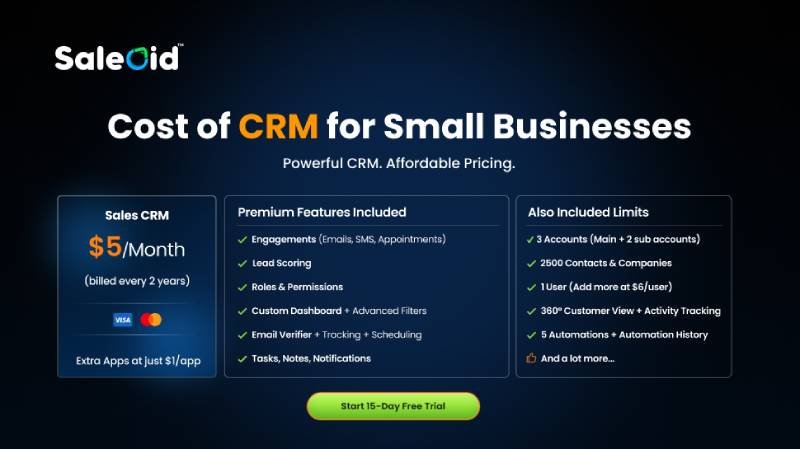
Plenty of CRMs advertise a low number, then move every useful feature behind a pricier tier. Saleoid works differently. Its AI CRM Software starts at a real $5 per month for the core plan, billed every two years, with individual apps like invoicing, forms, or appointments added for about a dollar each. There is no surprise jump from $5 to $49 the moment you need something essential, and no bloated bundle you are forced to buy into.
That matters because the entire problem with CRM pricing, as this guide has shown, is the gap between the advertized price and the real one. Saleoid closes that gap on purpose. You pay for the core, then add only the apps you switch on, so the number you see is the number you pay.
What You Actually Get for $5 a Month
Saleoid’s $5 core plan is more than a basic contact list. It includes:
- Email, SMS and appointment engagement
- Lead scoring
- Roles and permissions
- Custom dashboards and advanced filters
- Email verification, tracking and scheduling
- Tasks, notes and notifications
- Thousands of contact and company records
- A complete customer view with activity tracking
- Built-in automation
If you need more features, you can add apps such as email marketing, landing pages or online booking for around $1 per app.
This modular pricing means you do not have to pay more for a large bundle filled with tools you may never use. You can start with the essential CRM features and add new apps only when your business needs them.
The real cost of a CRM depends on how it is priced. Per-user bundles can become expensive as your team grows. Saleoid keeps costs under control by letting you pay only for the tools you choose to use.
Bottom Line: What a CRM Really Costs a Small Business
So, how much does a CRM cost for a small business? The answer is that the advertised price and the real price are two different numbers. Expect a visible range of $5 to $40 per user monthly for most small teams, but plan for a true cost that can run 2-4 times higher once seats, onboarding, add-ons, and AI enter the picture.
The businesses that spend the least are not the ones chasing the lowest sticker price. They are the ones who calculate the full cost, buy only for the workflows they use, and choose a pricing model that does not punish them for growing. Get those 3 things right, and a CRM stops being an expense you dread at renewal and becomes one of the smartest, most affordable investments your business makes.
Topics #CRM #CRM for small businesses